

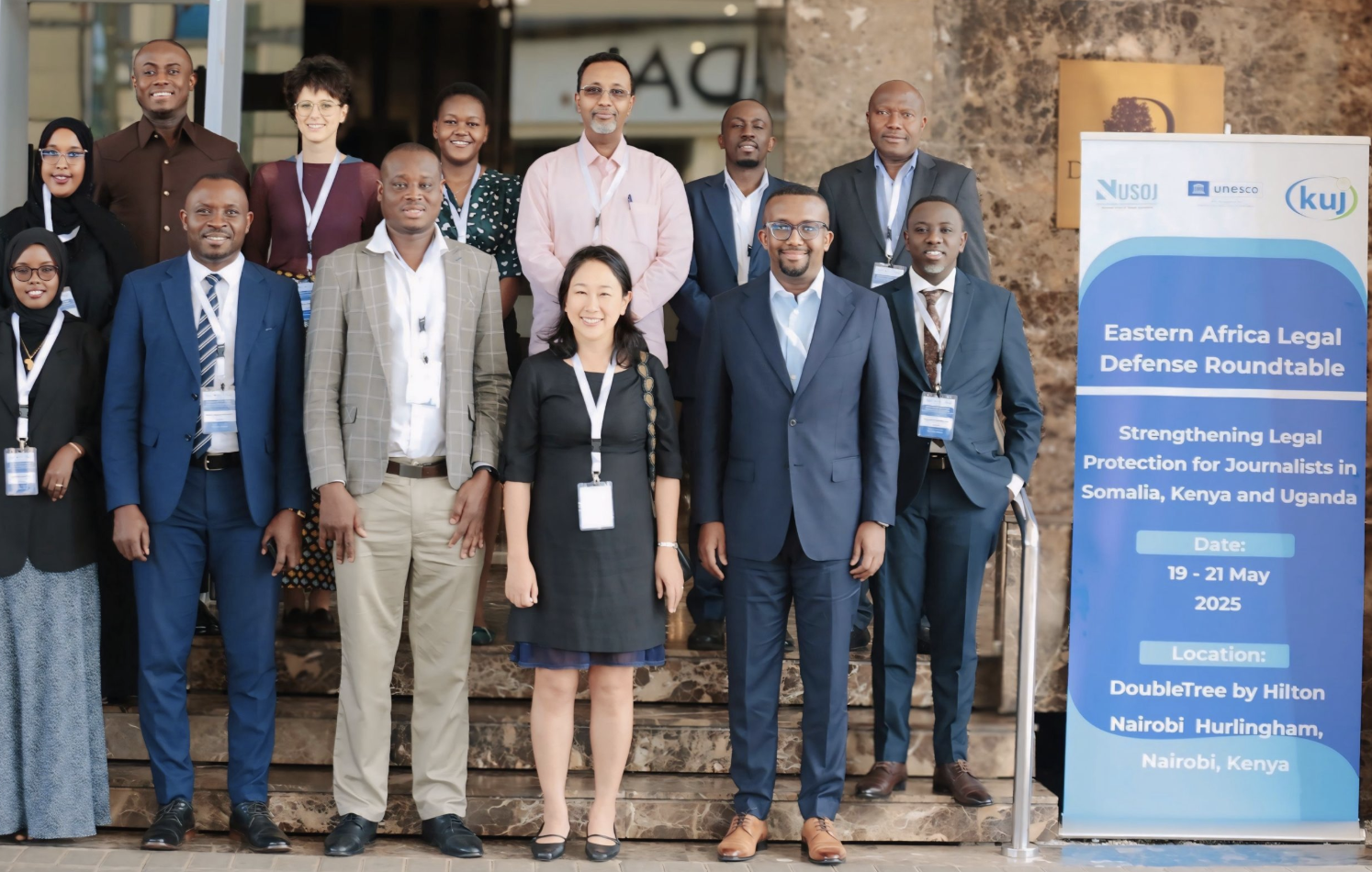
A landmark legal defense roundtable held in Mogadishu has called for the creation of a regional framework to protect journalists across Eastern Africa, responding to rising threats against the press amid shrinking civic space and political volatility.
The event, hosted by the National Union of Somali Journalists (NUSOJ) in collaboration with international press freedom organizations, brought together legal experts, civil society leaders, and representatives from media unions in Kenya, Uganda, Ethiopia, and South Sudan. The focus: forging a path toward legal harmonization that guarantees journalists’ rights regardless of national borders.
Journalists in the region continue to face censorship, arbitrary arrest, and violence — often with impunity. In Somalia, recent years have seen crackdowns on independent reporting, while in neighboring countries, journalists have faced growing digital surveillance and restrictive laws targeting “fake news” and “national security.”
The roundtable emphasized the need for cross-border legal defense teams, emergency response funds, and the establishment of a centralized regional hub to track and respond to media violations.
“Journalists are under siege across East Africa,” said Omar Faruk Osman, NUSOJ Secretary-General. “This roundtable is not just about Somalia — it’s about building a legal shield that protects truth-tellers wherever they work.”
The event concluded with a resolution urging national bar associations, ministries of justice, and media regulators to jointly draft protocols for the protection of journalists during elections, conflict coverage, and whistleblower investigations.
This initiative reflects a broader trend of media coalitions moving beyond national frameworks to seek regional solidarity in the face of authoritarian drift. With democracy under stress in many parts of East Africa, the legal defense of journalism has become a proxy battle for civic freedoms more broadly.
While ambitious, the plan will require sustained political will and donor backing — particularly to train legal defense teams and maintain rapid-response infrastructure in remote regions. But if successful, it could establish East Africa as a pioneering bloc for continental media rights.
The Mogadishu roundtable signals that Somalia — long a cautionary tale for press freedom — may now serve as an unexpected incubator for media rights innovation.
